Scientific information remains useful only when its source, methods, population and limitations stay attached to the reported result.
Cellular importance and clinical effectiveness are different claims
NAD+ is central to redox metabolism and serves as a substrate for enzymes involved in signalling and DNA repair. That biochemistry is well established, but it does not establish that externally administered NAD+ improves energy, cognition, recovery or aging outcomes.
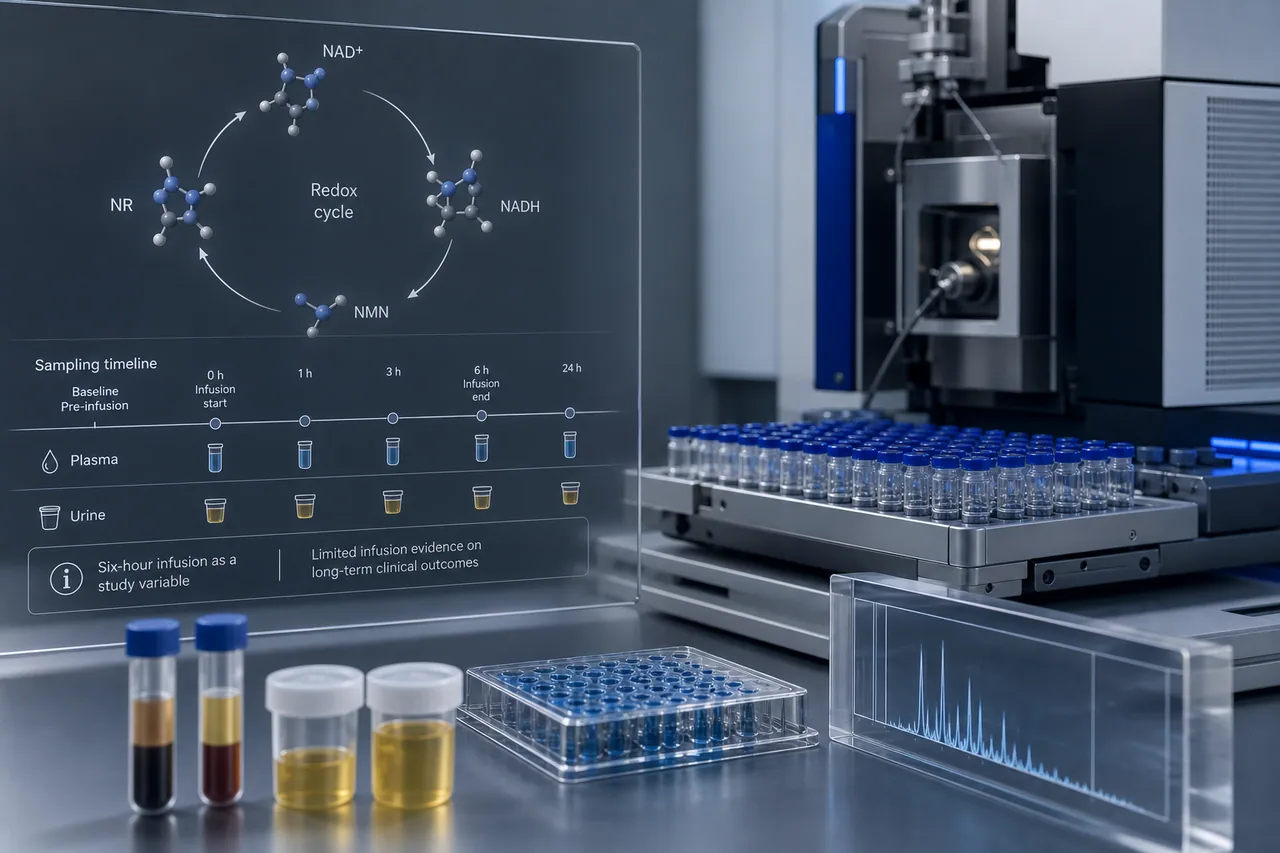
A 2019 pilot traced plasma and urinary metabolites during and after a six-hour intravenous NAD+ infusion. The work helps describe metabolic fate; it was not designed to demonstrate clinical efficacy.
Evidence should become more specific as a claim becomes more consequential.
Ask whether the study used NAD+ or a precursor
Nicotinamide riboside, nicotinamide mononucleotide and NAD+ are related but not interchangeable interventions. Precursor trials can show changes in the NAD metabolome without answering how direct NAD+ administration behaves.
A 2026 retrospective commercial-setting study compared tolerability records after intravenous NAD+ or nicotinamide riboside. It was not randomized, reported short follow-up and found differing symptom profiles, so it should be read as preliminary rather than definitive.
- Link to the original source.
- Name the study design and population.
- Report the observed endpoint factually.
- Disclose important limitations.
- Never convert trial reporting into a product recommendation.
Popular biomarker assumptions also need testing
A 2026 analysis across seven human cohorts found whole-blood NAD+ remained stable with age and lifestyle interventions. The result does not settle tissue-specific biology, but it challenges the claim that a low or declining whole-blood level is a universal marker of aging.
No personal protocol should be inferred from these records. They do not establish an anti-aging indication, an optimal infusion schedule, long-term safety or the meaning of a single commercial NAD+ measurement.
Primary references
These sources were checked against the linked publisher, regulator or literature-index record on 23 July 2026.
- Grant et al. Plasma and urine NAD+ metabolome during a six-hour infusion. Front Aging Neurosci. 2019. PMID 31572171.
- Reyna et al. Retrospective NAD+ versus NR infusion pilot. Front Aging. 2026. PMID 41704678.
- Trętowicz et al. Human whole-blood NAD+ across age and lifestyle interventions. Nat Metab. 2026. PMID 42135539.