Peptide · Vial
BPC 157
$8910mg
An experimental peptide best known for early research into tissue repair, tendon injury and wound response.

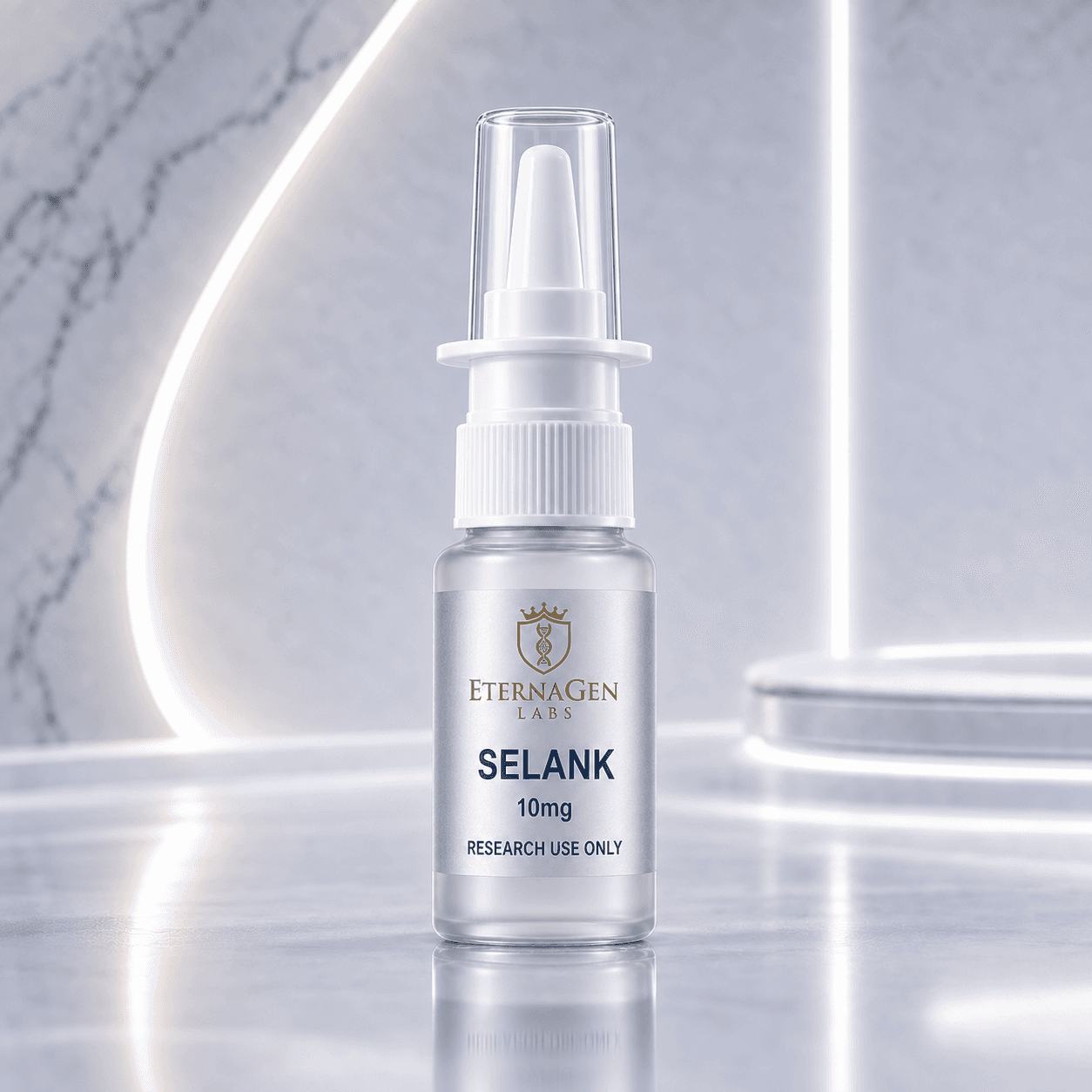 EternaGen / Research use only
Peptide · Research use only
A tuftsin-derived heptapeptide explored in stress-response, GABA-related and intranasal neurobiology research.
Available to approved purchasers
Can’t find the right record?Send support the product name or batch code.
Contact supportProduct information
A tuftsin-derived heptapeptide explored in stress-response, GABA-related and intranasal neurobiology research.
Selank has a small comparative human study and a wider mechanistic literature, much of it from animal or laboratory models. Independent replication, route-specific safety and clinically meaningful outcomes remain insufficiently established.
Selank is a synthetic seven-amino-acid peptide with the sequence Thr-Lys-Pro-Arg-Pro-Gly-Pro. It is derived from the immunomodulatory peptide tuftsin and appears in a limited body of human, animal and laboratory research.Specifications
Supplier-origin documentation will be published only after EternaGen verifies the source and record details.
This catalogue entry describes a research material, not an approved therapeutic formulation. Published findings do not provide directions for personal use and cannot verify the safety or performance of a separately sourced material.
Explore the research
Check what was studied, what researchers observed, and the limitation attached to each finding.
A 62-person comparative study reported psychometric outcomes for Selank and medazepam in generalized anxiety disorder and neurasthenia.
Evidence so far: Small single-study human evidenceLaboratory and animal work has examined GABA- and NMDA-receptor binding as possible explanatory pathways.
Evidence so far: Mechanistic and animal evidenceThe human evidence base is narrow, regionally concentrated and insufficient to establish broad efficacy or long-term safety.
Evidence so far: Major evidence gapProposed mechanism
Laboratory studies have examined Selank in relation to enkephalin degradation and GABA-receptor binding. Animal experiments suggest that administration route and strain can materially change the observed signal, which limits broad interpretation.
Evidence gaps
Primary sources
Related products
Peptide · Vial
An experimental peptide best known for early research into tissue repair, tendon injury and wound response.
Peptide · Vial
A naturally occurring copper-binding peptide explored in skin, collagen and wound-healing research.

Peptide · Pen
A peptide made inside mitochondria and studied for its connection to energy, exercise and metabolic stress.