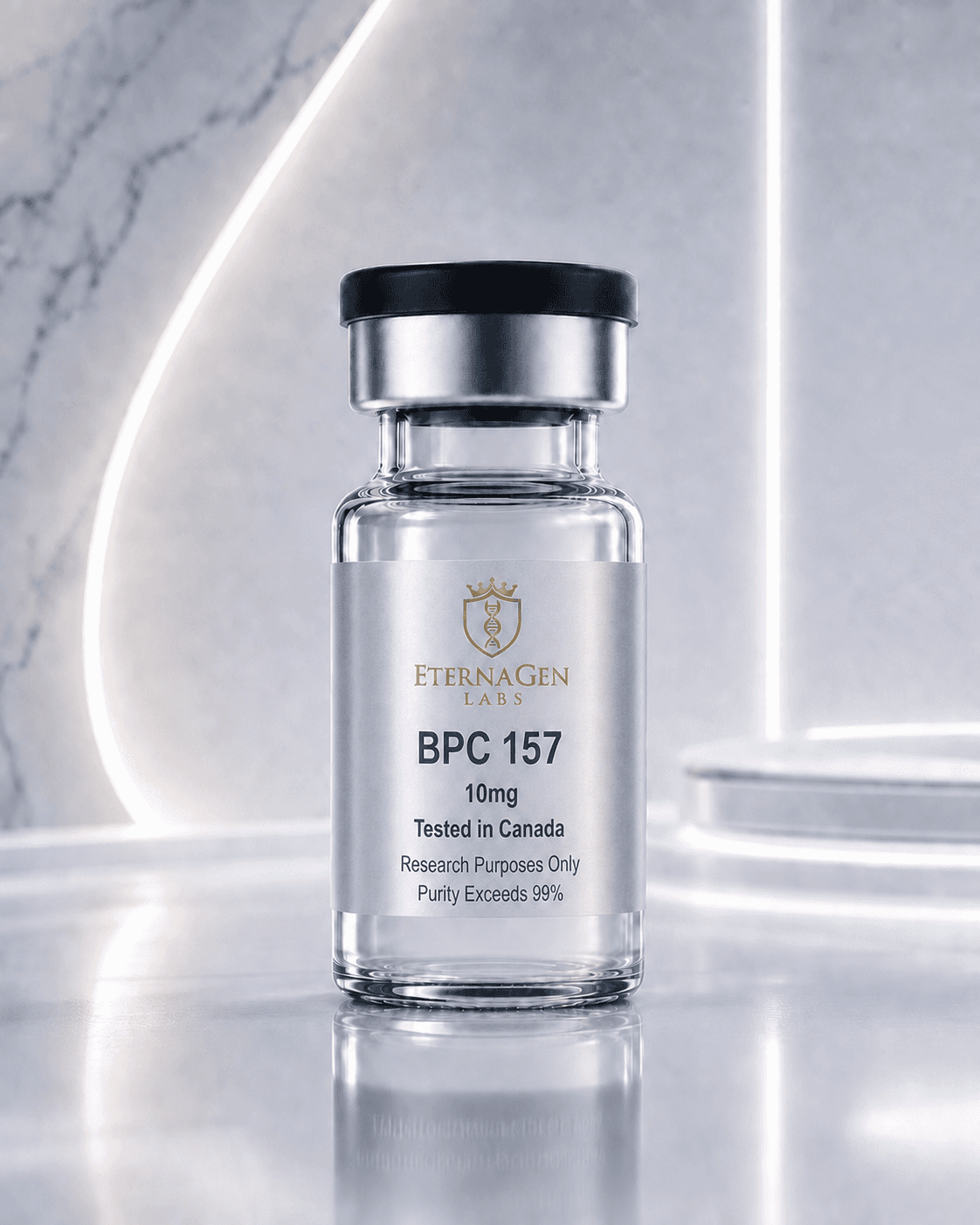
Peptide · Vial
BPC 157
$8910mg
An experimental peptide best known for early research into tissue repair, tendon injury and wound response.

 EternaGen / Research use only
Peptide · Research use only
A peptide made inside mitochondria and studied for its connection to energy, exercise and metabolic stress.
Available to approved purchasers
Can’t find the right record?Send support the product name or batch code.
Contact supportProduct information
A peptide made inside mitochondria and studied for its connection to energy, exercise and metabolic stress.
Small human studies have measured the MOTS-c that our bodies produce naturally. Research that actually administers MOTS-c has largely been limited to cells and animals, so those are two very different evidence questions.
MOTS-c is a 16-amino-acid peptide encoded within mitochondrial 12S rRNA. Research focuses on endogenous mitochondrial signalling, metabolic stress and exercise biology.Specifications
Supplier-origin documentation will be published only after EternaGen verifies the source and record details.
Health Canada lists the named compound or components among unauthorized injectable drugs identified in the Canadian market. A research-use label does not make an unauthorized product suitable or legal for personal use.
Explore the research
Check what was studied, what researchers observed, and the limitation attached to each finding.
Small human sampling studies examine whether acute exercise changes endogenous MOTS-c in muscle or circulation.
Evidence so far: Translational biomarker researchCell and mouse studies investigate glucose handling, skeletal-muscle metabolism and stress adaptation.
Evidence so far: Preclinical evidenceMouse experiments report changes in physical performance; this has not been established as a human treatment effect.
Evidence so far: Animal evidence onlyProposed mechanism
Cell and animal work suggests MOTS-c can respond to metabolic stress and influence nuclear gene expression and energy-related pathways. Human sampling studies measure endogenous MOTS-c; they do not test an administered MOTS-c product.
Evidence gaps
Primary sources
Related products
Peptide · Vial
An experimental peptide best known for early research into tissue repair, tendon injury and wound response.
Peptide · Vial
A naturally occurring copper-binding peptide explored in skin, collagen and wound-healing research.
Peptide · Vial
A synthetic peptide that mimics a natural signal involved in the release of growth hormone.