
Scientific information remains useful only when its source, methods, population and limitations stay attached to the reported result.
The population was specific
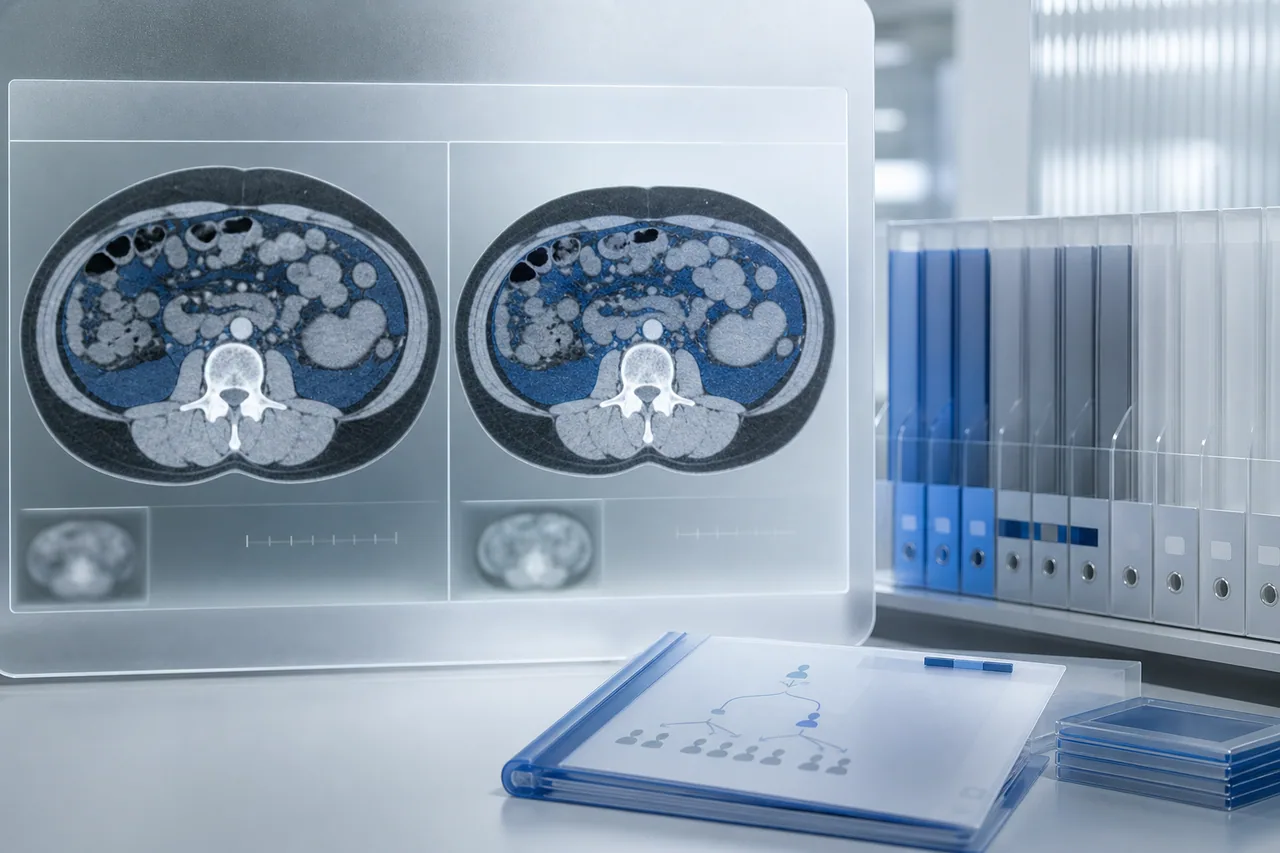
The pooled phase 3 programme enrolled 806 adults receiving antiretroviral therapy who had excess abdominal fat. Its initial 26-week randomized, placebo-controlled phase used computed-tomography measurement of visceral adipose tissue as the main outcome, followed by a 26-week extension.
A separate 12-month report described 404 participants in a sequential design. Participants initially assigned to tesamorelin were re-randomized at six months either to continue or switch to placebo; those originally assigned to placebo switched to active treatment. This design is important when reading the follow-up results.
Evidence should become more specific as a claim becomes more consequential.
Keep the measured endpoint and time point visible
In the pooled analysis, investigators reported a difference in visceral adipose tissue at week 26 between the randomized groups. The publication also reported measures such as lipids, body image and insulin-like growth factor 1; these are secondary or associated measures and should not be substituted for the primary endpoint.
The 404-participant report found that the observed reduction in visceral adipose tissue was not maintained in the group switched to placebo during the extension. This is a result within that protocol and population, not evidence about a separately sourced material or use outside the trial setting.
- Link to the original source.
- Name the study design and population.
- Report the observed endpoint factually.
- Disclose important limitations.
- Never convert trial reporting into a product recommendation.
What this programme cannot answer
The phase 3 population consisted of adults living with HIV who had excess abdominal fat while receiving antiretroviral therapy. Results cannot automatically be generalized to people without those characteristics, to another indication, or to a different formulation, dose or route.
The publications include investigator-reported safety observations, but a trial report is not a personal safety assessment. It does not establish suitability for an individual or for any research-only material. This page reports published study context only.
Primary references
These sources were checked against the linked publisher, regulator or literature-index record on 21 July 2026.
- Falutz et al. Effects of tesamorelin in HIV-infected patients with abdominal fat accumulation: randomized placebo-controlled trial with safety extension. J Acquir Immune Defic Syndr. 2010. PMID 20101189.
- Falutz et al. Pooled analysis of two multicenter phase 3 trials with safety-extension data. J Clin Endocrinol Metab. 2010. PMID 20554713.
- Stanley et al. Reduction in visceral adiposity and metabolic profile in HIV-infected patients receiving tesamorelin. Clin Infect Dis. 2012. PMID 22495074.